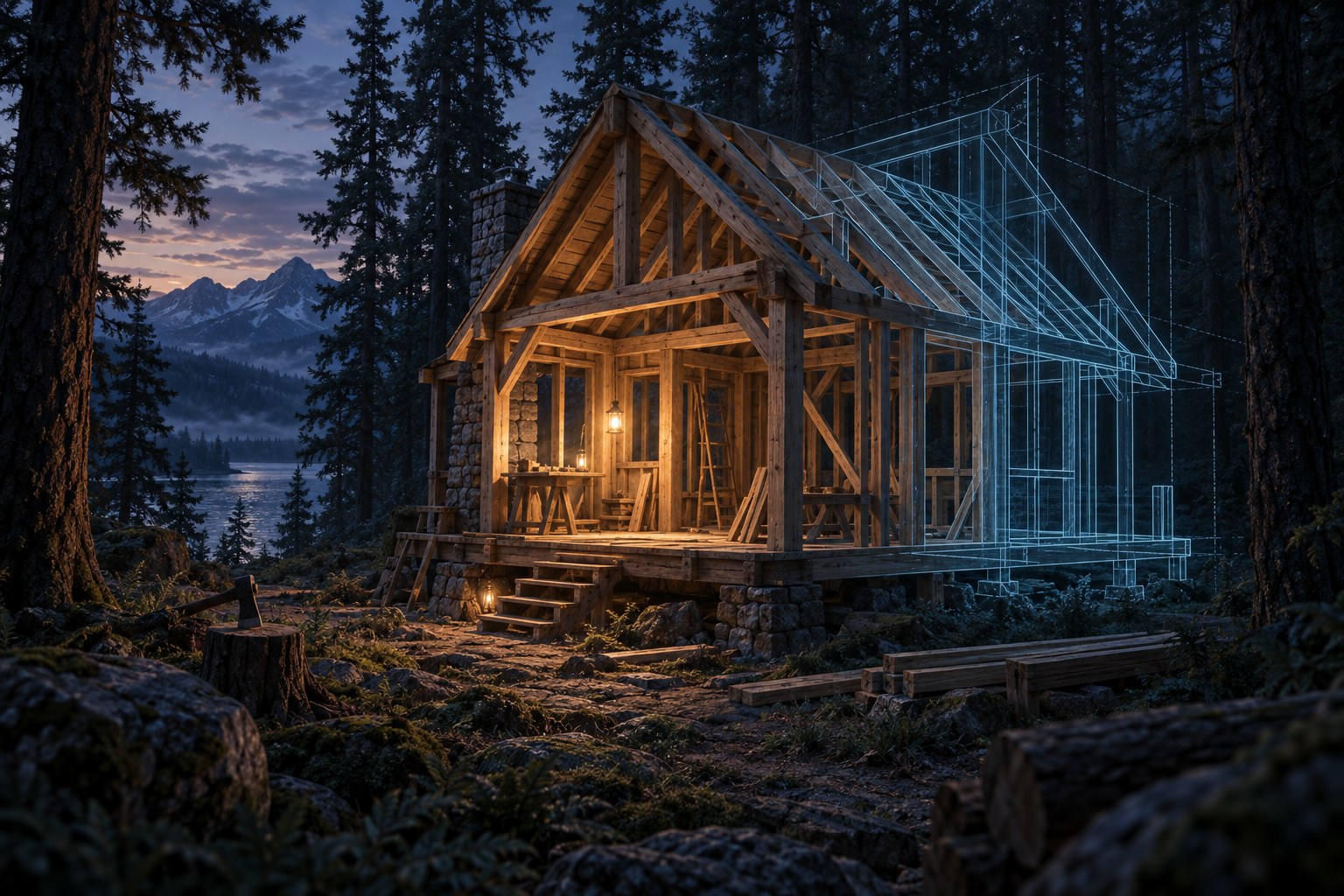
I’ve always wanted to build my own cabin in the woods. I have a rough understanding of the stages: digging, foundations, framing, wiring, plumbing, siding, roofing. What I don’t have is a clear picture of everything between those words.
That gap is where this game begins. I want someone to finish playing with a much better understanding of the project—and enough perspective to ask whether building a cabin is really for them.
This first entry documents the planning stage. There is a blueprint and a research library. There is no playable game yet.
Start before the first tree comes down
The experience should start with the land. You explore a wooded region, compare parcels, and then choose a building location within the parcel you buy. A beautiful view might come with a difficult access route. Cheap land might need expensive infrastructure. A place that looks perfect might turn out to have constraints you cannot see by walking around.
I want those discoveries to be part of playing. You consult a field guide, bring in specialists, weigh the findings, and make a decision. Building the cabin begins well before you pick up a tool.
Compress the repetitive labor. Preserve the fundamental steps.
That is the central rule in the first blueprint. Clearing a site cannot be a single button that makes the trees disappear. It includes decisions about access, vegetation to retain, debris, stumps, topsoil, and protecting exposed ground. The same attention needs to carry through the rest of the build.
Players do not need to place every identical board. They can understand one representative section and watch the crew finish the repetition. But a wall should not jump from bare studs to a finished surface without showing what went inside it.
Two ways to build
An hour is a useful introduction. It is also a tight limit for a subject this large. The answer we settled on is two modes that share the same underlying building process.
Guided Build
A 45–60 minute introduction with a few meaningful choices at each stage. The game explains problems before you commit and keeps a workable path to completion open.
Your Own Build
A longer project across multiple sessions. You investigate the land, coordinate people and deliveries, manage the money, and recover when the plan changes.
In the guided mode, putting the cabin in the wrong place could reveal an animated runoff pattern and an explanation. You then choose between suitable alternatives. In the independent mode, you take more responsibility for obtaining that information before committing.
The field guide stays available in both. Looking something up should be part of managing a project well.
The people are part of the game
I wanted the experts to be invented characters with different levels of experience and different prices. That grew into a more interesting idea: experience matters in relation to the work, and a quote needs to be understood as a scope of work.
The blueprint proposes three excavation contractors. Mara has extensive experience on wooded slopes, charges more, and is booked ahead. Eli is an established local operator suited to straightforward sites. Sam is newly independent after working on a crew, with lower overhead and less experience on difficult ground.
These are proposed characters, not finished game systems. The goal is to make each a reasonable choice in the right circumstances. The most expensive expert should not always be best, and a newer contractor should not automatically be incompetent.
A useful decision might be as simple as noticing that one quote includes stump disposal and another does not. Advice, investigation, execution, and review can also be separate services. Knowing when to ask for help is part of the lesson.
A calendar that means something
The project also needs external pressures. The working scenario starts in early summer, with a target of making the cabin weather-tight before winter.
Playtime and construction time are different. A short interaction can represent days of work. Reading the guide does not consume those days. Before you commit, you see the expected effect on money and schedule.
A rain forecast might prompt you to protect exposed ground or reschedule work. An available contractor is only useful if the site is ready. A delayed delivery can affect the trades booked after it. I want the pressure to come from connections the player can understand, with ways to recover when things go wrong.
The reading comes before the rules
I started collecting construction references in a folder called Building Game. Three documents anchor the first research pass:
- Catalogue of House Building Construction Systems · 1960
Published by Canada’s Central Mortgage and Housing Corporation. Its classification system and illustrated case sheets help organize different ways a house can be constructed. - Residential Structural Design Guide · 2017
HUD’s second edition gives us a structural reference for loads, foundations, wood framing, lateral resistance, and connections. - Wood-Frame House Construction · 1955
USDA Agriculture Handbook No. 73 provides a practical map of construction tasks, from location and excavation through finishes and maintenance.
The older books are useful, but I do not want publication dates to disappear when their contents become game lessons. We need newer, applicable references for the details, and qualified review before claiming the game’s instruction is validated.
The source register therefore distinguishes finding a relevant chapter from checking a lesson. It also records gaps: site preparation, complete enclosure details, utilities, local requirements, and current costs. The books themselves are not reproduced on this site.
What the blueprint actually contains
I used Codex as a collaborator to turn the conversation into a written planning package. The first version described the experience, mapped 49 learning topics, and allocated a proposed 58 minutes to the guided route. That is a design target, not a measured playthrough.
The initial draft proposed a modest, single-story cabin. I have since chosen a setting closer to home: the North Cascades, in the mountains of the Pacific Northwest. I also want stairs leading to a loft. The revised plan keeps a roughly 600-square-foot main floor and adds the loft, with its exact size and use still to be decided.
That amendment brings the curriculum to 51 topics. The stairs and loft need to shape the layout, roof, structural support, and inspection lessons from the beginning. The working site is a fictional private parcel in the broader North Cascades region; the exact locality and elevation still need to be selected.
The planning document includes the modes, characters, construction stages, budget and calendar systems, and criteria for the first playable sample.
Download the blueprint · MarkdownVersion 0.2 adds the North Cascades setting, stairs to a loft, and the browser, iPhone, and Android target. This is a game design document, not a construction manual.
Build a small piece—and test it
The next planned milestone is a 12–15 minute playable section: compare sites, investigate the ground, choose a location and an expert, prepare the site, respond to rain, and construct the foundation. It should demonstrate the learning and the visual quality together.
I want the finished game to run in a desktop web browser and on iPhone and Android. The initial plan is a touch-friendly browser experience on mobile, with native app-store versions left as a separate decision. That makes performance and controls part of the design from the beginning.
The blog will live on Netlify, with its source on GitHub. Future entries will document the work as it happens: decisions, prototypes, mistakes, changes, and what testing teaches us. For now, the first thing built is the plan.
Written from the project’s planning conversations and blueprint. Prepared with Codex. Concept artwork is AI-generated and does not depict an implemented game or a validated construction assembly.